¿Prefieres leer esto en español? Esta página también está disponible en español latinoamericano.

Ver en español
EN ES
Reserve

Rev 3.1 · ATtiny84A watchdog + Bluetooth LE

Your car won't start without your phone.

The GT-1 sits in series with your ignition line and listens for a Bluetooth heartbeat from your phone. Walk out of range and the engine is dead on the next start — no SIM card, no cloud account, no monthly fee.

  • Normally-closed relay
  • Works with no internet
  • Installs in the ignition line
  • 12 V vehicles, negative ground
Block diagram: your phone sends a Bluetooth LE heartbeat to the BLE module, the ATtiny84A watchdog drives a 30 A relay whose normally-closed contact sits in series with the ignition line.
Phone → BLE heartbeat → watchdog → 30 A relay in the ignition line.
1 sheartbeat pulse every ~5 s
10 sof silence and the device is armed
60 suntil the aggressive-mode cut
30 Aautomotive relay contact

How it works

A heartbeat, not a remote control

There is nothing to press and nothing to remember. While your phone is connected the module keeps beating; the moment the pulses stop, the device arms itself.

  1. Pair once with the app

    Your phone talks to the module over Bluetooth Low Energy. No account, no cloud, no SIM — the link never leaves the car.

  2. The module keeps beating

    While the app is connected the module's STAT output pulses HIGH for about one second, roughly every five seconds. Every pulse counts as “still authorised”.

  3. Silence arms the device

    Ten seconds without a pulse and the state machine is ARMED. What happens next depends on the mode you ordered.

  4. Back in range, instantly disarmed

    The next pulse returns the device to DISARMED — the relay releases and the normally-closed contact restores the ignition line.

Timing diagram of the STAT heartbeat: pulses one second long about every five seconds, then silence for about ten seconds, after which the device state changes from DISARMED to ARMED.
STAT heartbeat: 1 s HIGH every ~5 s. About 10 s of silence turns the state ARMED.

Two behaviours

Choose how hard it stops

The operating mode is a firmware constant burned into the microcontroller — nothing on the board can be flipped after the fact, so pick one per unit when you order.

Calm mode

Nobody gets stranded mid-drive

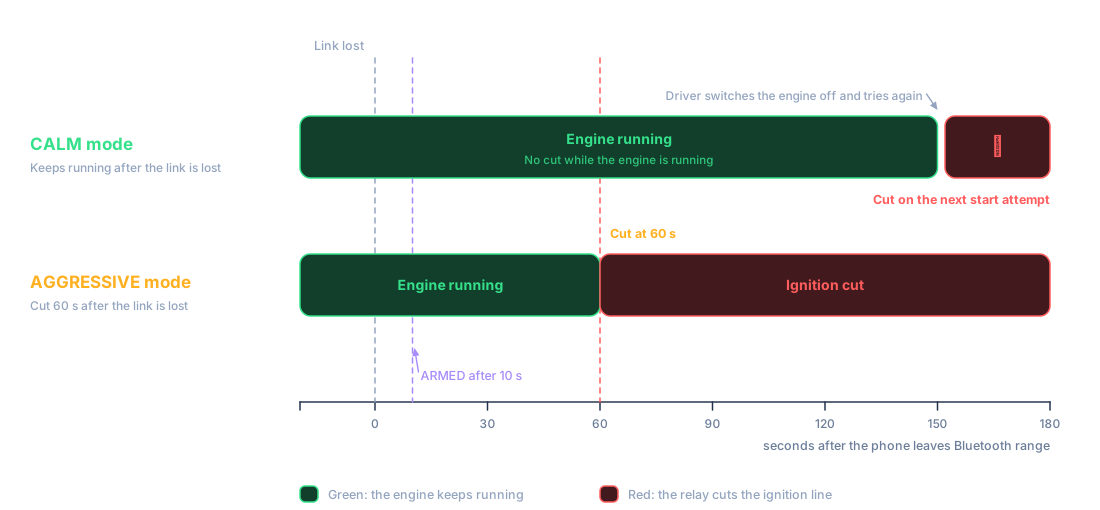
If the engine is already running when the link drops, it keeps running. The ignition line is cut only on the next start attempt while the device is still armed.

  • Engine already running → keeps running
  • Ignition off and on again while armed → no start
  • No sudden stall in traffic or at a red light

Best for Daily drivers, taxis, ride-hailing and delivery cars — anyone who cannot afford an engine that dies mid-route because a phone battery ran out.
Aggressive mode

Engine off 60 seconds after the link drops

The moment the phone leaves range a roughly 60-second timer starts. If the ignition is on when it expires, the relay cuts the ignition line.

  • Link lost → 60 s timer starts
  • Timer expires with ignition on → the engine stops
  • Phone back in range → timer resets, ignition restored

Best for Vehicles parked overnight in high-risk areas, and owners who want the engine to die while the car is being driven away.

Timeline comparison: in calm mode the engine keeps running after the link is lost and is only cut on the next start attempt; in aggressive mode the relay cuts the ignition 60 seconds after the link is lost.
Calm mode waits for the next start attempt; aggressive mode cuts 60 s after the link is lost.

One mode per unit. Timing is derived from the microcontroller's internal watchdog RC oscillator, so the 10 s and 60 s windows are approximate — around ±10 % in practice, which is intentional for this revision. No crystal-accurate clock is used.

Fail-safe by design

If anything fails, your car still starts

Every layer of the GT-1 is built so that the failure direction is “the vehicle keeps working”, not “the vehicle is dead”.

Four layers of protection: a normally-closed relay, a 100 kilo-ohm pull-down on DISALLOW, a 2.7 volt supervisor with brown-out reset, and automotive input protection.
Hardware, microcontroller, firmware and vehicle — four independent safety layers.

Normally-closed relay

With no power at all the contact 30 → 87a stays closed, so a dead module, a blown fuse or a removed battery leaves the ignition circuit exactly as the factory built it.

Nothing to jam, nothing to subscribe to

The only link is local Bluetooth Low Energy. There is no GSM radio to jam, no server to block, no data plan and no subscription that can expire or go unpaid.

Clean recovery

A 2.7 V reset supervisor plus the brown-out fuse hold the microcontroller in reset while the pack is flat, so a sag, a recharge or a battery swap always ends in a clean boot.

Automotive-grade inputs

A P6KE24A TVS for load dump, a series diode for reverse polarity, BAT85 clamps on the ignition sense and two snap-on ferrite beads on the way in.

Watchdog that cannot be left undriven

DISALLOW is pulled low by a 100 kΩ resistor, so the relay cannot be energised while the MCU is in reset, being programmed, or un-programmed.

One honest limitation. An immobiliser cannot stop a tow truck or someone who finds and removes the module. What it does stop is the easy drive-away theft: without an authorised phone in range, the engine will not start — even if the module has been disconnected from the vehicle battery, because the watchdog runs from its own 1S Li-ion pack.

Real hardware

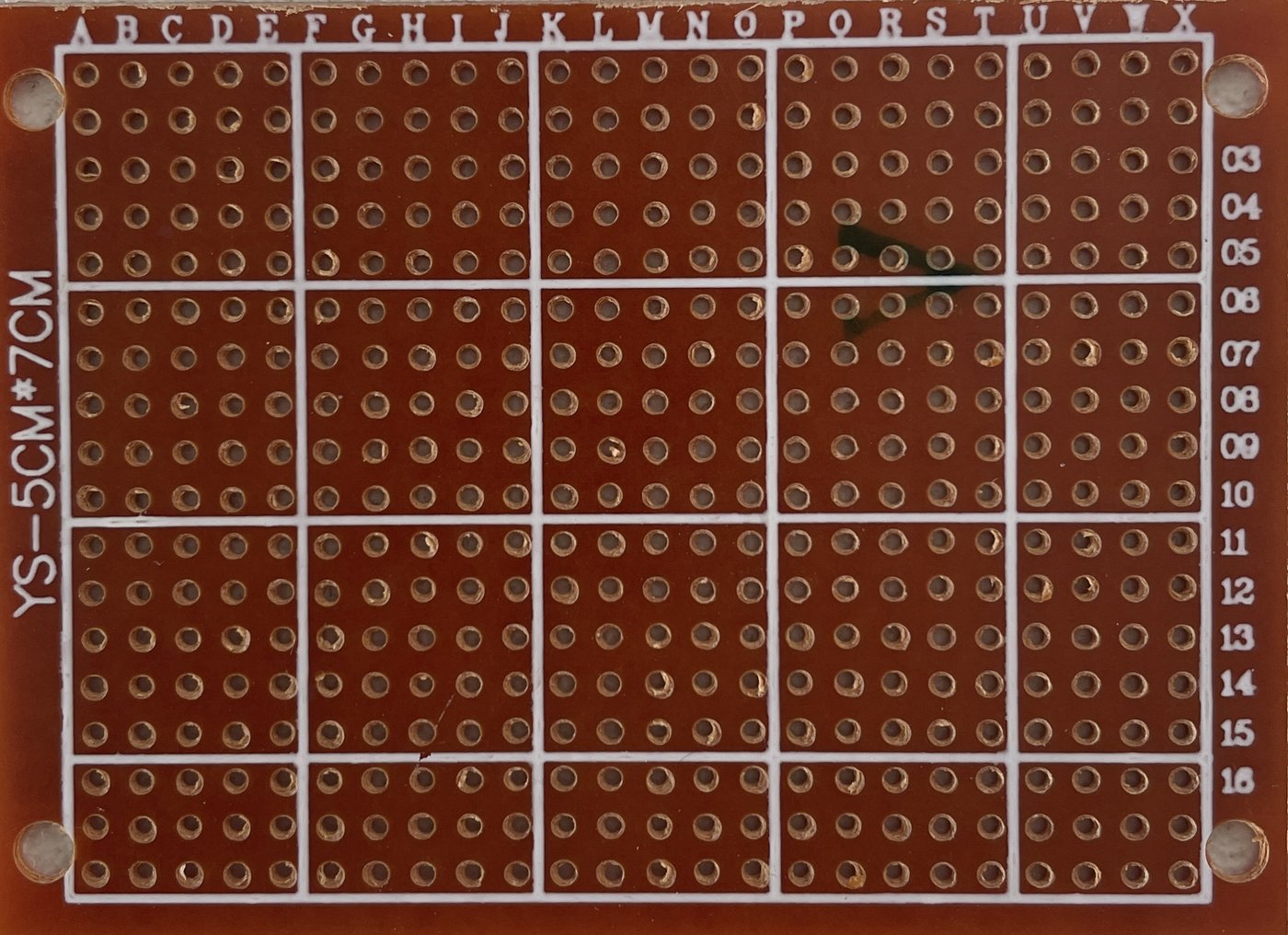
One 50 × 70 mm board on a real 2.54 mm hole grid

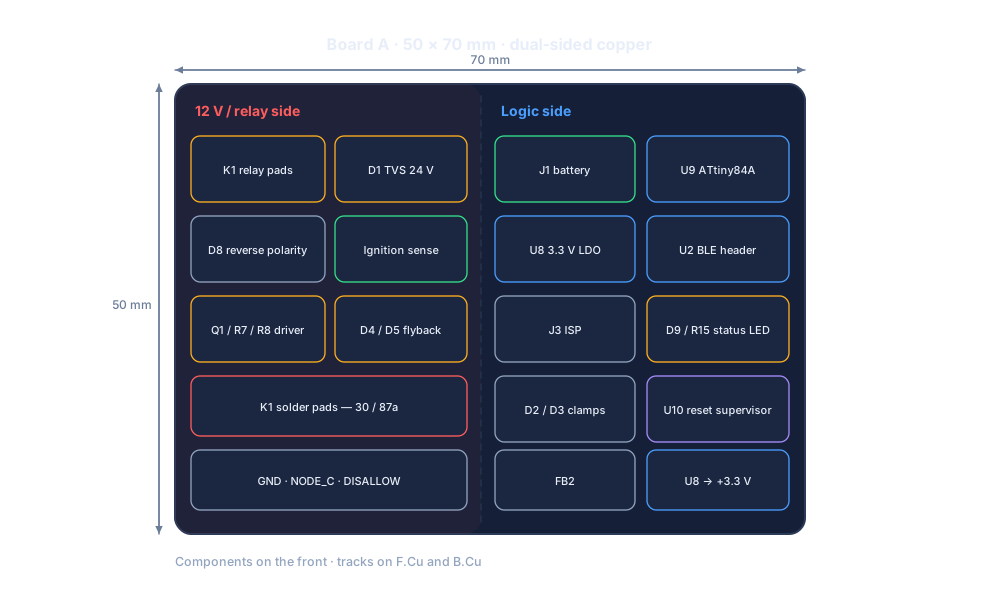
No development kit taped to a breadboard: the whole device — 12 V side, relay driver, microprocessor and Bluetooth module — is a single dual-sided board, and every pad is snapped to the hole grid of the panel photographed below.

Functional layout of board A: the 12 volt and relay side on the left, the logic side with the ATtiny84A, 3.3 volt regulator, Bluetooth header and programming header on the right.
Board A: 12 V / relay side and logic side on 50 × 70 mm of dual-sided copper.
Photograph of the 50 by 70 millimetre prototype panel from the component side, showing the 24 by 18 hole grid on a 2.54 millimetre pitch.
The panel behind the layout — 24 × 18 holes on a 2.54 mm grid
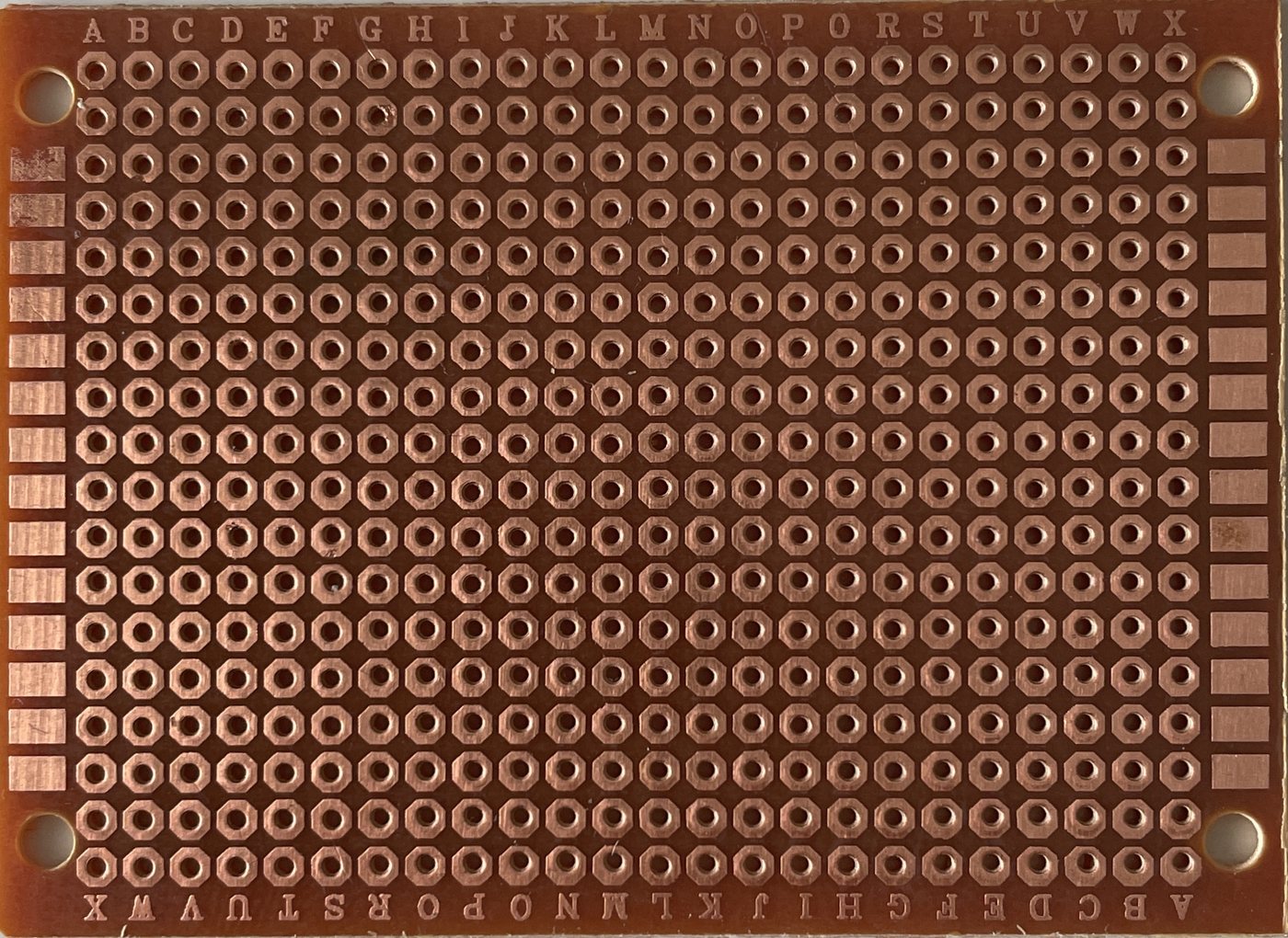
Photograph of the same prototype panel from the copper side, showing one copper strip per row of holes.
The same panel, copper side
  • Single board, dual-sided copper (F.Cu + B.Cu), through-hole components.
  • Every pad snaps to the 2.54 mm hole grid, so the finished board matches the hand-built prototype hole for hole.
  • Off-board 12 V automotive relay on flying leads — the board never carries the load current.
  • Firmware updatable through the on-board AVR ISP header, so the mode can be rebuilt.
  • Full design package (netlist, SPICE model, board files, firmware) kept under version control.

Specifications

Every part, in plain language

Taken straight from the engineering specification of revision 3.1 — no marketing round-up of the numbers.

Electronics
MicrocontrollerMicrochip ATtiny84A, 8-bit AVR — watchdog, timer and state machine
RadioBluetooth Low Energy module with a STAT heartbeat output
BLE supplyMCP1700 3.3 V LDO, 250 mA — 3.3 V at the module, peak draw under 50 mA
Logic supply1S Li-ion pack, 3.4–4.2 V, filtered by a snap-on ferrite
Reset supervisionMCP100 2.7 V open-drain supervisor + 10 kΩ pull-up
Ignition sensing390 kΩ / 68 kΩ divider with a 100 nF filter, compared against the 1.1 V internal bandgap
ProgrammingAVR ISP 6-pin header (MISO, SCK, MOSI, RESET, VCC, GND)
Status LEDOptional 3 mm indicator, on exactly while a cut is being requested (Pro build)
Switching and protection
Relay12 V automotive SPDT, 30 A contact, terminals 30 / 85 / 86 / 87 / 87a
Contact modeNormally closed — unpowered relay passes the ignition feed straight through
Relay driverBC517 Darlington with a 10 kΩ base resistor and 68 kΩ bleed to ground
Coil protection1N4007 plus FR107 fast-recovery flyback diodes in parallel
Load dumpP6KE24A 24 V, 600 W TVS diode
Reverse polarity1N4007 in series with the 12 V input
Transient clamps2 × BAT85 Schottky on the ignition sense node
EMI2 × 5 mm snap-on ferrite beads (12 V input lead and logic rail)
Timing
Heartbeat pulse~1 s HIGH, repeating roughly every 5 s while authorised
Arming delay~10 s without a pulse
Power-on grace~10 s disarmed so the app can reconnect after a battery swap
Aggressive timer~60 s after the state becomes ARMED
Time baseInternal watchdog RC oscillator, ~250 ms tick — approximate by design
Physical
Board50 × 70 mm, dual-sided copper, front-mounted components
Relay mountingOff-board, flying leads soldered to the board pads
Connections2-pin battery input, 6-pin BLE header, 6-pin ISP header
Vehicle system12 V negative ground (passenger cars, pickups, vans)
ConsumptionBLE module under 50 mA peak; the logic runs from its own pack

Installation

Four wires, one cut, no dashboard surgery

The GT-1 goes in the ignition feed — not in the starter, not in the alarm and not in the fuel pump. The original fuse stays in series.

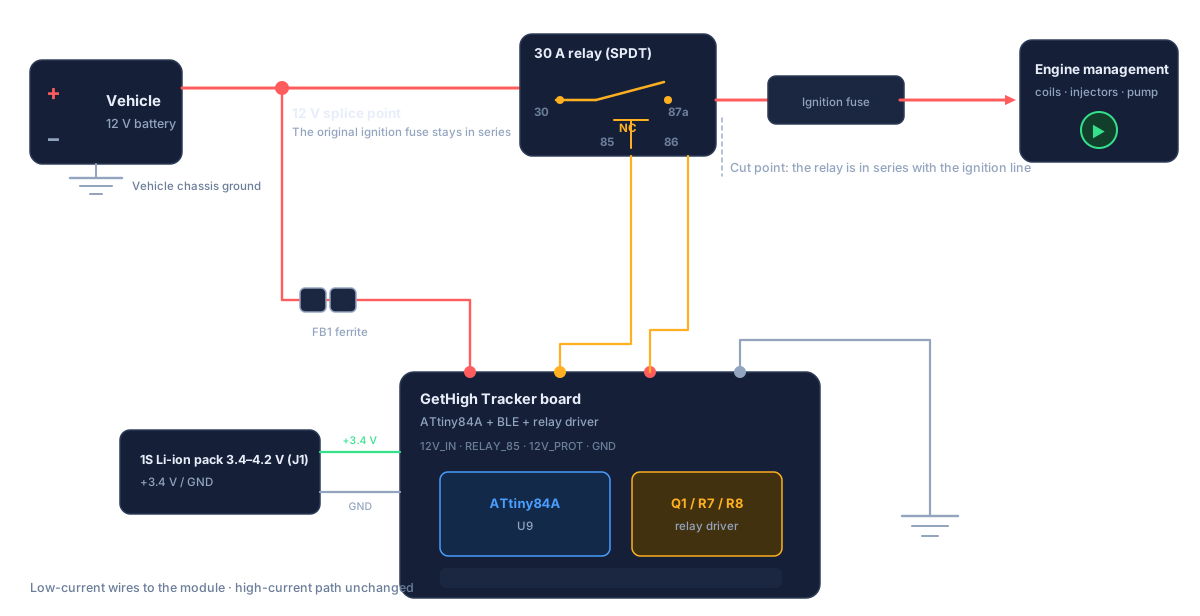
Vehicle wiring diagram: the 12 volt battery feeds a splice point that supplies the relay terminal 30 and, through a ferrite bead, the tracker board. The normally-closed contact feeds terminal 87a, then the original ignition fuse and the engine management. Terminals 85 and 86 go to the board coil driver and the board ground goes to chassis.
The relay is in series with the ignition line; the high-current path keeps the original fuse.
  1. Find the ignition feed

    Locate the wire that feeds the ignition circuit at the fuse box. Confirm it goes dead when the key is removed.

  2. Cut and splice

    Splice the source side to relay terminal 30 and the load side to 87a. The original fuse stays in the circuit; the relay never carries the starter current.

  3. Feed the module

    Run the 12 V input lead through the supplied ferrite bead to the board, and the coil wires to terminals 85 and 86. Bolt the ground to the chassis.

  4. Connect the logic pack and pair

    Plug the 1S Li-ion pack into J1, pair your phone with the app, and check that the heartbeat keeps the relay released before closing the panel.

Professional installation recommended. The GT-1 must be installed on a vehicle you own or are authorised to modify. Cutting the wrong wire can damage the electrical system.

Check your local rules. Immobilisers are widely used and legal for your own vehicle across Latin America, but requirements and insurer conditions vary by country. Confirm the rules that apply to you and tell your insurer before installing.

Fitted by an installer? Everything you need — the colour wiring diagram, the relay terminal map and the ISP programming pinout — ships printed in Spanish with every unit, and the same diagrams are on this page.

Pre-order

Two builds, one decision

The first test batch is being assembled now. Reserve a unit and we will confirm stock, shipping cost to your country and the right wire for your vehicle before you pay anything.

GT-1 Basic

$89 USD

Status LED omitted — the lowest possible drain from the logic pack while a cut is active.

  • 50 × 70 mm controller board, assembled and tested
  • 30 A automotive relay + pre-crimped harness
  • Two snap-on ferrite beads and the 1S Li-ion pack
  • Your choice of CALM or AGGRESSIVE firmware
  • Printed Spanish wiring guide
  • 12-month warranty
Reserve the Basic

Prices are in US dollars for shipments inside Latin America and include the batch test report. Shipping is quoted per country after your reservation. Do you need several units for a fleet? Ask about the volume price.

Reserve your unit on WhatsApp

Fill in the form and we will open WhatsApp with your reservation ready to send. No payment now, no card details, no account: we answer personally, in Spanish or English.

  • We confirm the exact shipping cost to your country first.
  • We check that your vehicle's ignition feed matches the installation diagram.
  • You choose CALM or AGGRESSIVE mode when we confirm the build.

We only use your details to answer this enquiry. Nothing is uploaded to a third-party server by this page.

Latin America

Shipped across the region, explained in Spanish

Orders are packed by hand in small batches and shipped with door-to-door tracking. Support is in Latin American Spanish, on WhatsApp, with the person who built your unit.

  • Mexico
  • Guatemala
  • El Salvador
  • Honduras
  • Costa Rica
  • Panama
  • Dominican Republic
  • Colombia
  • Ecuador
  • Peru
  • Bolivia
  • Chile
  • Argentina
  • Uruguay
  • Paraguay

Can't see your country? Ask — we ship to the rest of the region by quote.

USD prices, no surprises

Prices are quoted in US dollars, the way hardware is priced across the region. Import duties, if any, are set by your country's customs and are not included.

Installer network, growing

We are building a list of installers per city who have fitted the GT-1. Tell us where you are during your reservation and we will share the closest one.

Questions

The things buyers ask us first

Will it work with my car?

Any vehicle with a 12 V negative-ground electrical system and a reachable ignition feed: cars, pickups, SUVs and vans. Tell us the year and model with your reservation and we confirm the exact wire before shipping. For 12 V motorcycles, ask us first — the relay and harness are sized for car currents.

Do I need internet, a SIM card or a subscription?

No. The only link is Bluetooth Low Energy between your phone and the module inside the car. There is no data plan, no monthly fee, no app account and nothing to renew. The device keeps working in a garage with no signal, which is exactly where cars get stolen.

What happens if my phone dies or is left behind?

About 10 seconds without a heartbeat and the device is armed. In CALM mode an engine that is already running keeps running and is cut only on the next start attempt; in AGGRESSIVE mode the relay cuts the ignition 60 seconds after the link is lost. Get back in range with an authorised phone and the device disarms immediately.

Does it drain the vehicle battery?

The logic runs from its own 1S Li-ion pack, not from the car battery, so the watchdog keeps working even if someone disconnects the vehicle battery — that is the entire point. The vehicle only supplies the relay coil, and only while a cut is actually being requested.

Can it be bypassed?

Every immobiliser can be defeated by a tow truck, or by someone who finds and removes the module. The GT-1 makes a quick drive-away theft impossible and buys you time; treat it as one layer of security, not a substitute for parking carefully and insuring the vehicle.

Is it legal where I live?

Immobilisers are widely used and are legal for your own vehicle across most of Latin America, but the rules and the requirements your insurer imposes differ by country. Check the local regulations that apply to you and mention the installation to your insurer before fitting it.

Who installs it?

Any 12 V auto-electrician can fit it in under an hour with the printed Spanish wiring guide that ships in the box; the whole job is one cut and one splice in the ignition feed. If you are not comfortable working on the vehicle's electrical system, have it installed professionally.

What is the status LED for?

On the Pro build a 3 mm LED lights up exactly while the device is requesting a cut — in calm mode during the start attempt that gets blocked, and in aggressive mode after the 60-second timer expires. It is a diagnostic aid for whoever installs and tests the unit, and it draws only about 1–2 mA while active. The Basic build omits it to save pack energy.

What is not finished yet?

This is a working revision 3.1 prototype heading into a 100-unit test batch. The production decision on the status LED and a tighter time base (an external 32.768 kHz oscillator for crystal-accurate timing) will be taken after that batch reports back. Reservations are taken in order and you will be told exactly which build you are getting.

WhatsApp